

Introduction : A Practical Framework for Building a More Neuroinclusive Workforce
Organizations everywhere are talking about neurodiversity. Some are focused on accommodations. Others are investing in recruiting programs, manager training, employee support, or workforce performance. A growing number are beginning to think about what AI and workforce transformation mean for neurodivergent employees.
The challenge is that organizations are often at very different stages of maturity.
Through daily conversations with HR leaders, benefits leaders, ERG sponsors, disability and inclusion professionals, talent acquisition teams, and brokers, we consistently see organizations progressing through four stages of neurodiversity maturity.
The Neurodiversity Maturity Model helps organizations understand where they are today, where they want to go next, and what leading organizations are doing differently.
The Four Stages

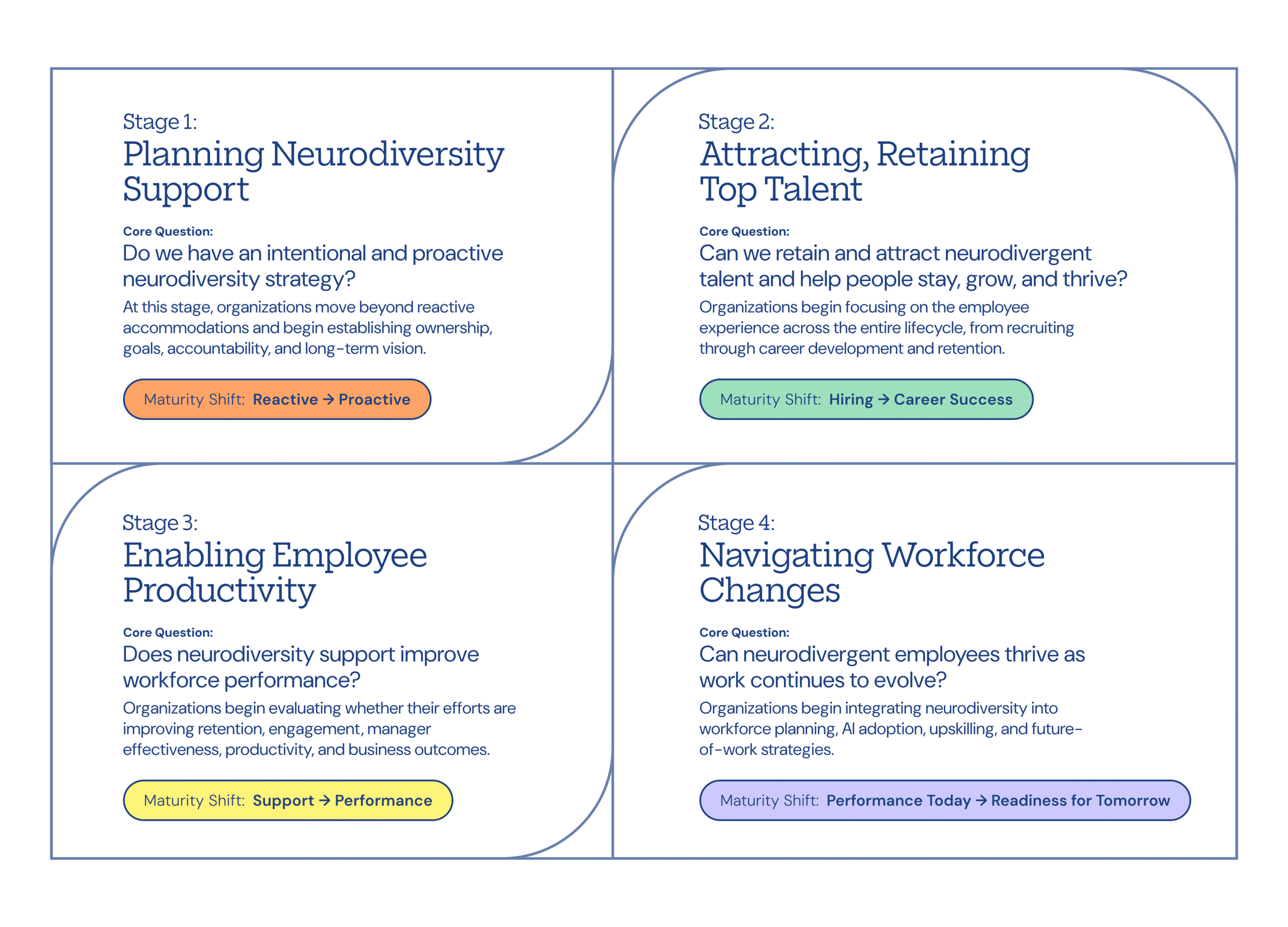
Stage 1:
Planning Neurodiversity Support
What This Stage Looks Like
Organizations at this stage are building the foundation.
They are moving beyond responding to accommodations requests and beginning to establish a more proactive strategy. Ownership becomes clearer. Success metrics begin to emerge. Leaders start defining what support should look like across the organization.
What We’re Seeing in the Market
Leading organizations are:
- Establishing executive sponsorship
- Assigning formal ownership
- Creating neurodiversity roadmaps
- Developing employee communities and ERGs
- Establishing measures of success
- Aligning neurodiversity with broader business priorities
The biggest difference between emerging and mature organizations at this stage is intentionality.
Ideas to Consider
- Who owns neurodiversity strategy in our organization?
- How do we currently define success?
- Do we know the population we are trying to support?
- Is neurodiversity part of our workforce strategy or primarily handled through accommodations?
- Do employees know where to go for support?
Stage 2:
Attracting, Retaining & Supporting Talent
What This Stage Looks Like
Organizations recognize that recruiting neurodivergent talent is only one part of the equation.
The focus shifts toward helping employees succeed after they are hired through manager support, career development, coaching, community, and caregiver resources.
What We’re Seeing in the Market
Leading organizations are:
- Building neuroinclusive recruiting practices
- Training managers
- Strengthening ERGs and communities
- Offering individualized support resources
- Supporting caregivers
- Focusing on career growth and retention
The most common gap we see is between hiring and supporting. Many organizations have recruiting initiatives but fewer have structured support throughout the employee lifecycle.
Ideas to Consider
- What happens after a neurodivergent employee is hired?
- Are managers equipped to support diverse work styles?
- Do employees have access to specialized support when challenges arise?
- Are caregivers supported?
- How do we measure retention and career progression?
Stage 3:
Enabling Workforce Productivity
What This Stage Looks Like
Neurodiversity becomes more than an inclusion initiative.
Organizations begin viewing support as a way to improve workforce effectiveness, manager capability, employee engagement, retention, and operational performance.
The discussion shifts from access to outcomes.
What We’re Seeing in the Market
Leading organizations are:
- Measuring workforce outcomes
- Quantifying retention impact
- Tracking manager effectiveness
- Evaluating productivity improvements
- Connecting support programs to business priorities
- Building business cases for continued investment
Many organizations measure participation and utilization. Fewer measure workforce performance outcomes.
Ideas to Consider
- What outcomes matter most to our organization?
- Are we measuring more than program participation?
- How does manager effectiveness influence employee success?
- Can we connect support efforts to retention or productivity?
- How do we demonstrate business value to leadership?
Stage 4:
Navigating AI & Workforce Transformation
What This Stage Looks Like
Organizations begin preparing for the future.
As AI changes how people work, neurodiversity becomes an important consideration in workforce planning, reskilling, technology adoption, and organizational design.
The focus expands beyond supporting today’s workforce to preparing for tomorrow’s.
What We’re Seeing in the Market
Leading organizations are:
- Including neurodiversity in AI conversations
- Evaluating cognitive load and work design
- Supporting workforce reskilling
- Considering accessibility in AI initiatives
- Designing technology with diverse users in mind
- Using AI to reduce friction and improve performance
While nearly every large employer is discussing AI, relatively few have explicitly connected those conversations to neurodiversity.
Ideas to Consider
- How will AI change the employee experience?
- Are neurodivergent employees included in future workforce planning?
- Which roles are likely to change the most?
- How are we preparing employees for new ways of working?
- Where can AI remove friction and improve performance?
Conclusion
Organizations do not become neurodiversity leaders overnight.
The strongest programs evolve over time, moving from accommodations and awareness to talent strategy, workforce performance, and ultimately future workforce readiness.
The Neurodiversity Maturity Model is not designed to judge where an organization stands today. It is designed to clarify what comes next.
The organizations making the greatest progress are asking better questions, learning from their employees, and taking deliberate steps forward.
The journey begins with understanding your current stage and identifying the next meaningful step toward a more neuroinclusive, high-performing workforce.